


Choosing the Right IOL Power in Borderline Astigmatism - non toric IOL power calculator!
Updated: Apr 12
The clinical dilemma
Imagine planning an EDOF or diffractive multifocal IOL in a patient with borderline corneal astigmatism.
The astigmatism is too low to justify a toric IOL
Yet high enough to potentially degrade visual quality, especially with premium optics
The real-world scenario
In this case in image 1 below
Keratometry shows ~0.81 D astigmatism
The IOL of choice highlighted is 26.50 against a spherical equivalent (SE) of -.11 with the SRK T formula.
This falls into a grey zone for implanting a toric IOL may:
Offer minimal additional benefit
Introduce risk of rotation or misalignment
Potentially worsen outcomes rather than improve them
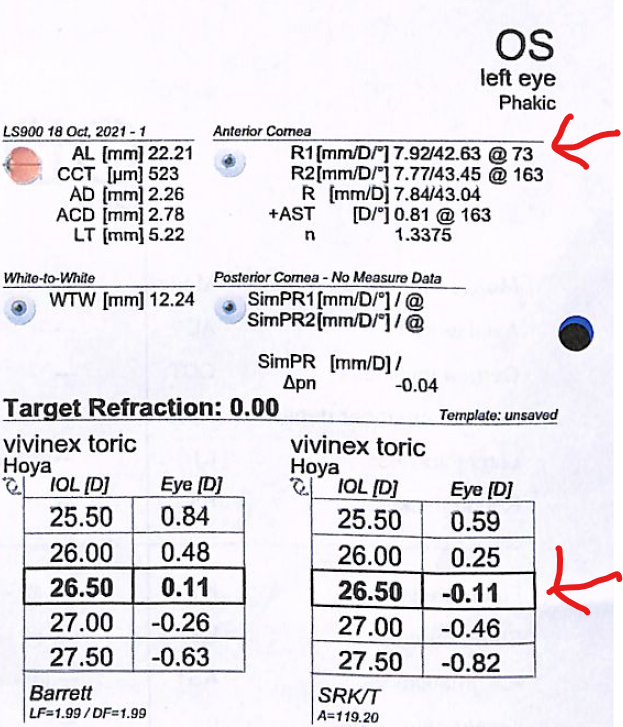
Taking anterior K readings into consideration
⚠️ Where the misunderstanding happens
Now look at the biometry output.
For example:
A 26.50 D IOL predicts -.11 D
At first glance:👉 This appears to be an ideal near-emmetropic outcome
But this is where the key mistake occurs:
-0.11 is not pure sphere — it is spherical equivalent (SE)
What spherical equivalent really means:
Spherical equivalent is defined as:
SE= Sphere + 1/2 (cyl)
So a predicted -0.11 SE actually represents:
A combination of sphere and cylinder
Not a true zero spherical outcome
What the calculator does:
As demonstrated below in image 2, the quickguide non-Toric Calculator, provides you the expected spherical and cylinder power of the patient post IOL implantation as per choice of standard biometry. It also suggests the new IOL power, taking into consideration the expected spherical power.

Why this matters in premium IOLs:
With monofocal IOLs, small residual cylinder may be tolerated.
But with:
EDOF IOLs
Diffractive multifocal IOLs
Even low levels of residual astigmatism can:
Reduce contrast
Degrade image quality
Affect patient satisfaction
The key insight:
When you implant a non-toric IOL:
The IOL corrects SE
The corneal astigmatism remains
The final refraction is a distribution of that SE into sphere and cylinder
Therefore:
A “good SE” does not guarantee a good spherical outcome
What you should actually aim for
Instead of targeting:
❌ SE ≈ 0
You should aim for:
✔ Sphere ≈ 0
How to approach this clinically:
To do this, you must:
Take the predicted SE from biometry
Account for the corneal astigmatism
Separate the SE into:
Sphere
Cylinder
Only then can you judge whether:
The spherical component is truly near zero
Or whether it is offset by residual astigmatism
💡 What this calculator does
This is exactly where the calculator helps.
It takes:
Predicted spherical equivalent (SE)
Corneal astigmatism (K values)
And converts it into:
True spherical component (S)
Residual cylinder
Meridional power distribution
Why this changes your decision
By isolating the spherical component, the calculator allows you to:
Choose an IOL power that gives near-zero sphere
Avoid being misled by a “good” SE value
Optimize outcomes in premium IOL patients
Final takeaway
“In borderline astigmatism, spherical equivalent can be deceptive. The real goal is not zero SE — but zero sphere.”
Subscribe to access the quickguide non-Toric calculator and improve refractive outcomes:


