top of page

Complete Guide to IOL Power Calculation - Advanced Masterclass


The topics discussed in Masterclass are at an advanced level !!

If you have not covered the basics, you are requested to first go through the Biometry section in this website, before you take the course.


For complete understanding you can reach out for a tailor made course for your team


Section 1- Understanding Modern Formula Architecture

.

Why different formulas behave differently


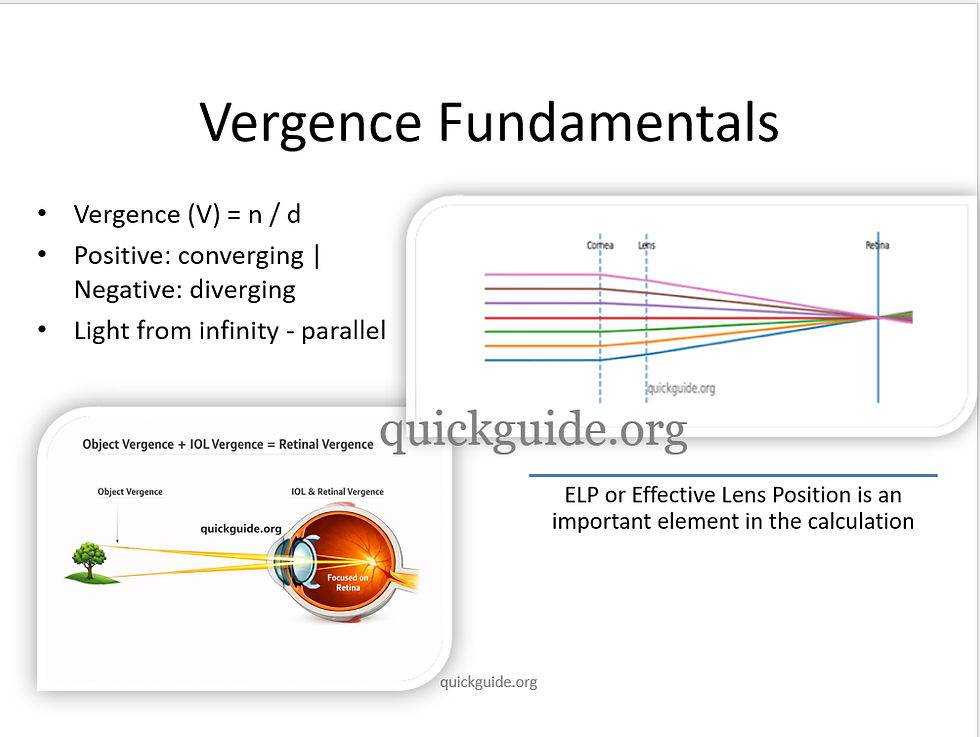
What do we mean by vergence?    Fig 1
What do we mean by vergence? Fig 1

Vergence describes how “converging” or “diverging” a bundle of light rays is at a given plane in the eye. Parallel rays of light has zero vergence. As light rays pass through the cornea, the optical power of cornea makes the light rays converge. Vergence describes the converging power of cornea and how far the rays of light will travel further to reach the lens. Thus vergence studies the power of the cornea and the lens to converge the rays of light and the distance the rays of light travel, after passing through bother cornea and lens to reach the retina.


Vergence formula, v = n/d where n is the refractive index of medium and d is the distance the rays of light travel.


Thus all modern IOL formulas are fundamentally vergence based formula. First, they study the vergence of light rays (L) at the IOL plane, the emergent vergence of light rays (L') after they emerge passing through the IOL (which will have a certain power F).


The formula is therefore,

Fig 2         Thus vergence of light rays passing after crossing the IOL is dependent of the refractive index of vitreous, and the length of the vitreous chamber through which the rays of light will travel to reach the retina.
Fig 2 Thus vergence of light rays passing after crossing the IOL is dependent of the refractive index of vitreous, and the length of the vitreous chamber through which the rays of light will travel to reach the retina.

In the equation above, vergence of light rays after passing through the IOL will have to take into account the refractive index of vitreous (1.336). The denominator, AL-ELP signifies the posterior segment length up to the retina (ELP is the distance between the cornea and the refracting plane of the IOL)


Similarly, the vergence of incoming rays of light that pass through the cornea and reach the IOL has to be also taken into account.


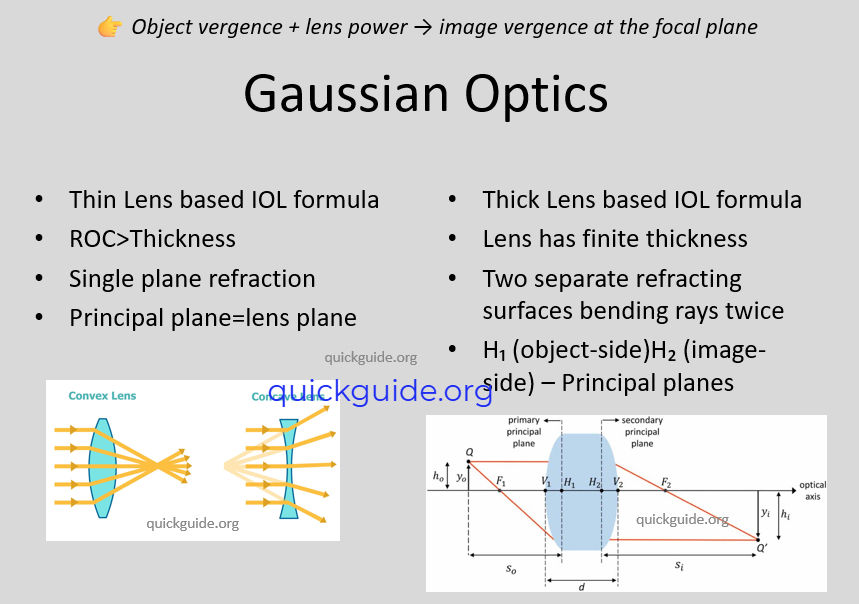
Fig 3      Difference between thin and thick lens optics        quickguide.org
Fig 3 Difference between thin and thick lens optics quickguide.org

Next we will see IOL calculation formula according to thin and thick lens mathematical formulas.


  1. What is the difference between thin and thick lens IOL calculation vergence based formulas?


    Power of any lens, be it glass power, or a lens used in microscope or telescope can be calculated mathematically by Gauss think and/or thick lens formula. In a thin lens formula, provided by Gauss, the lens is considered so thin that the thickness of the lens is not considered. The entire refraction is considered to happen in only one plane. IOL calculation formulas of second and third generation, like the SRK T, Hoffer Q, the Holladay I, etc. are based on thin lens optical formula of Gauss. ELP or effective lens position is the distance from the cornea to the refraction plane of the IOL.


    In this context, it is important to remember that the ELP is not a physical distance from the cornea to the IOL refraction plane. It is a virtual value that is back-calculated from post operative refraction of pseudophakic patients, and built in the formula. It is a virtual distance, and not a physical distance from the cornea to the IOL refraction plane.


Fig 4        The thick optics lens power calculation. Note this vergence based formula takes into consideration the central thickness (t) which is reflected in the equation.           quickguide.org
Fig 4 The thick optics lens power calculation. Note this vergence based formula takes into consideration the central thickness (t) which is reflected in the equation. quickguide.org


On the other hand in thick lens formula, the lens thickness is taken into account. Thus in

thick lens formula there are two planes of refraction. These are the first and second

principal planes. For a biconvex IOL, the two principal planes sit inside the IOL. The focal

length of the IOL is the distance from the second principal plane to the point where all

rays of light converge.

Fig 5        The first and second principal planes of a lens. The focal length is the distance from the second principal plane to the red dot where the rays of light are converging.    quickguide.org
Fig 5 The first and second principal planes of a lens. The focal length is the distance from the second principal plane to the red dot where the rays of light are converging. quickguide.org


  1. Which of the IOL formulas are based on thin and thick optics vergence formula?


Fig 6       The red box indicate IOL calculation formulas that are based on thin optics mathematics, while the blue boxes indicate IOL calculation formulas that are based on thick optics mathematics.      quickguide.org
Fig 6 The red box indicate IOL calculation formulas that are based on thin optics mathematics, while the blue boxes indicate IOL calculation formulas that are based on thick optics mathematics. quickguide.org


The older two variable formula like the SRK T, Hoffer Q and Holladay I are based on thin optics vergence formula. These formulas do not consider the IOL as a thick optics lens. They assume that the entire refraction is happening in one single plane in the IOL.


  1. What are the advantages of IOL calculation formula based on thick optics vergence formula?


The principal planes of refraction in an IOL is not a fixed position. It moves with the change in the IOL power. The rate of change of the position of the principal planes of refraction is more as you move from an average IOL power ( say 21.0 diopter) to a high power IOL ( say 30.0 diopter). The first principal plane shifts anterior, that is towards the anterior curvature of the IOL, while the second principal plane shifts towards the posterior surface of the IOL. Since the second principal plane shifts posterior as the curvature of IOL becomes more steeper (for a high power IOL), there is a chance of myopic surprise, when A constant of the IOL is not optimized for the high power IOL, that is hyperopes.


Add to this, different IOL manufacturing companies, have IOLs that do not change their anterior and posterior radius of curvature linearly from a low power IOL to a high power IOL. Therefore, using the same constant for high power IOLs may lead to refractive surprise. Shape factor is a term given to understand how an IOL shape changes as a function of anterior to posterior radius changes from a low to a high power IOL. Many IOL models are not biconvex symmetrical but have a nonzero shape factor S = (R1 + R2)/(R1 − R2), with R1 and R2 being anterior and posterior lens radii, respectively. This shape factor often changes between power levels which may cause refractive surprise when used with a standard constant (say A constant for the IOL).


The change in the principal plane location of two  IOLs with different refractive index as a function of the IOL power. Conceptual only       quickguide.org
The change in the principal plane location of two IOLs with different refractive index as a function of the IOL power. Conceptual only quickguide.org

The thick lens IOL calculation formula, like the Barrett Universal II formula, considers the changes in the principal planes of refraction as one moves from a low power IOL to an high power IOL. Barrett Universal formula is an unpublished formula. However, this formula has studied a standard AcrySof IOL, to understand how the principal planes of refraction shift.


  1. Refractive Index(RI) of an IOL, and the change in principal planes of refraction based on IOL power. Which of the two IOLs will be more forgiving in short eyes?


Both IOLs with high and low refractive index(RI), will have a change in the location of second principal plane of refraction with change in IOL power. This can lead to unexpected refractive surprise. But the change in the second principal plane of refraction between an IOL with high RI is less than with an IOL with lower RI. Therefore an IOL with a RI of 1.55 will be more forgiving than an IOL with a RI of 1.47.


  1. What is the difference between modern thick lens IOL calculation formulas like the Barrett and the EVO or Olsen formula?


Earlier I have explained the difference between the older two variable formula and the Barrett formula, that is formulas that are based on thin lens optics, and formula like Barrett or Olsen which is based on thick lens optics.


Now we will cover what is the difference between Barrett, Olsen and EVO formulas which are all based on thick lens optics. A detailed description is given in the following article : A Brief explanation of modern IOL power calculation formulas https://www.quickguide.org/post/a-brief-explanation-of-modern-iol-power-calculation-formulas


Barrett Universal II

Olsen Formula

EVO

Kane

Paraxial vergence based thick lens formula

Ray tracing thick lens formula

Paraxial vergence based thick lens formula

Thin lens formula with regression analysis and Artificial intelligence to predict IOL power and ELP

Does not account for spherical aberration that takes place when rays pass through periphery of cornea

Takes into account positive spherical aberration through ray tracing

Does not account for spherical aberration that takes place when rays pass through periphery of cornea

Does not account for spherical aberration.

Based on Gaussian thick lens formula

Based on Snell's law of refraction at each corneal interface

Based on Gaussian thick lens formula

Based on Gaussian thin lens formula.

No sum of segments or CMAL modification of axial length

No sum of segments or CMAL modification of axial length

Uses sum of segments approach through CMAL modification of axial length by turning axial length based on group refractive index into CMAL modified axial length

No sum of segments approach.

Physical details of particular IOLs are not required

Because of application of ray tracing physical details of IOLs like lens thickness and refractive index along with radius of curvature of anterior and posterior surface of IOL of a 22 diopter standard IOL required

Physical details of particular IOLs are not required

Physical details of particular IOLs are not required


Section 2

Role of Effective Lens Position (ELP) vs Predicted ACD in IOL Power Calculation


What Is Effective Lens Position (ELP)? How is it different from predicted ACD?


ELP is the theoretical axial location of the IOL’s principal plane used inside the vergence formula to predict postoperative refraction.


Key characteristics:


It is not the physical location of the IOL optic. It is a mathematical construct inside the formula.

It determines the effective optical power delivered at the retina. Thus it is a virtual number and not a physical or real number. It is arrived by IOL calculation formulas by understanding refractive outcomes and back calculating the ELP value through regression formula.


On the other hand, predicted ACD is the estimated postoperative distance from the corneal reference surface (usually epithelium) to the anterior surface of the IOL. Thus it is a physical distance.


My own calculator here helps you to understand the predicted ACD based on pre operative ACD and lens thickness. Post operatively you can do a pseudophakic biometry and see how far is the IOL sitting from the cornea and match with the predicted ACD. This will give you an idea if any refractive surprise is the result of post operative physical position of the IOL.


What is the method of ELP prediction by different IOL calculation formulas?


Different IOL calculation formulas employ different strategies to predict ELP. The thin optics based Holladay I and SRK T formulas predict ELP based on patient axial length and corneal readings. Haigis formula however do not use corneal power as a method to predict ELP. Instead the Haigis formula uses the axial length and pre operative ACD to predict ELP, a point to be noted which will be useful in our discussions for post lasik IOL calculation formula.


Amongst the thick lens formulas, the Olsen uses the C constant method that in turn predicts ELP based on lens thickness and pre operative ACD. Barrett uses the Lens Factor to predict the ELP, which in turn is based on the A constant of IOL, the corneal power, axial length, the white to white and the lens thickness. The EVO formula


Key point to remember - Predicted ACD is a physical distance from the corneal epithelium to the anterior surface of the IOL, while ELP is a virtual distance built in the IOL formula from the cornea to the principal plane of refraction of the IOL. In a thick lens formula like Barrett Universal II, the ELP corresponds to a virtual distance from the corneal second principal plane to the second principal plane of the IOL.


What is the impact of post ACD error on refraction of patient?


Olsen states that ±0.7 mm axial displacement of the IOL is the equivalent to a ±1 D shift in IOL power in a normal sized eye. The effect is, however, very dependent on the axial length of the eye. Generally, for an average axial length, a .1 mm of IOL displacement may result in a .19 diopter effect on the refractive outcome. The refractive error is more pronounced in short eyes and less pronounced in high axial length patients.


Section 3

Total Keratometry & Posterior Cornea Concepts


This is an ongoing article and keep an eye on this blog for frequent updates


-----------------------------------------------------------------------------------------------------------------------------------


Essentials in Ophthalmology : ELP Estimation 34;Lens Power Calculation Formulas

Services

Online consultation

online consultation.jpg

If you are interested to learn more on any of the content in this website, you are free to subscribe and drop me a message for an online consultation against a coffee.

bottom of page